The purpose of this blog post is to compare American Renaissance faires vs European medieval festivals. To arrive at these conclusions I will give first-hand experiences of local festivals both in the U.S. and Europe. Particularly, I will paint a more in-depth picture of a local medieval festival near me in Livorno, Italy. Nearby is the city of Florence, my adopted city where I live part of the year. You can also use this information as a travel guide to inspire your festival adventures in Europe. One thing is certain, people want to connect with the past or make an escape from their modern daily lives. They may achieve this by immersing themselves in these faires and take the role of an historic or fantasy figure. In the U.S. this could include attending as a Viking warrior or a winged fairy. This scene is different in Europe. Read below to learn more about Renaissance faires vs medieval festivals and their cultural differences and plan accordingly.
American Renaissance Faires vs European Medieval Festivals: What’s the Real Difference?
The Origins of American Renaissance Faires
Before I begin describing their differences, it is important to understand how American Renaissance faires emerged. The faire actually originated in Los Angeles, California in 1963 from a husband and wife couple. They used it as a fundraiser for a radio station and to educate the neighborhood children. It was an immersive living history event featuring a recreated Elizabethan village, entertainers in period costume, and handcrafted items. Many still love these basic components of the faire. This couple took inspiration from the Italian Renaissance style of theater called commedia dell’arte. This peformance depicts traveling wagons along with a medieval pageant wagon shown in a children’s book. They also had the idea of recreating open-air European medieval festivals in their own way. This set the stage for American Renaissance Faires through the 1970s and beyond. Since then many more events and different themes have been added across the country.
Popular Attractions at American Renaissance Faires
One American Renaissance faire that I am also a vendor is The Delaware Renaissance Faire in Townsend, Delaware. It takes place every fall and runs for three weekends and grows every year. Another faire that I am also a vendor is the Bucks County Renaissance Faire in Doylestown, Pennsylvania. These faires help recreate the atmosphere of the period with blacksmithing demonstrations, falconry, a recreation of a dungeon chamber, pottery demonstrations, and highly talented artists. One such artist is 3D2U, which sells handmade crafts including wood working, laser engraving, 3D printing, and much more. Another standout artisan, Twisted Creativity, captures the spirit of medieval craftsmanship, handwoven chainmaille art with each piece crafted by hand and available for faire goers and online visitors to purchase. For those drawn to the call of steel, The Armory Myakka offers a stunning display of handcrafted knives, daggers, and swords. Each piece echoes the artistry of ancient forges and far-off medieval lands.


Entertainment and Performances at American Renaissance Faires vs European Medieval Festivals
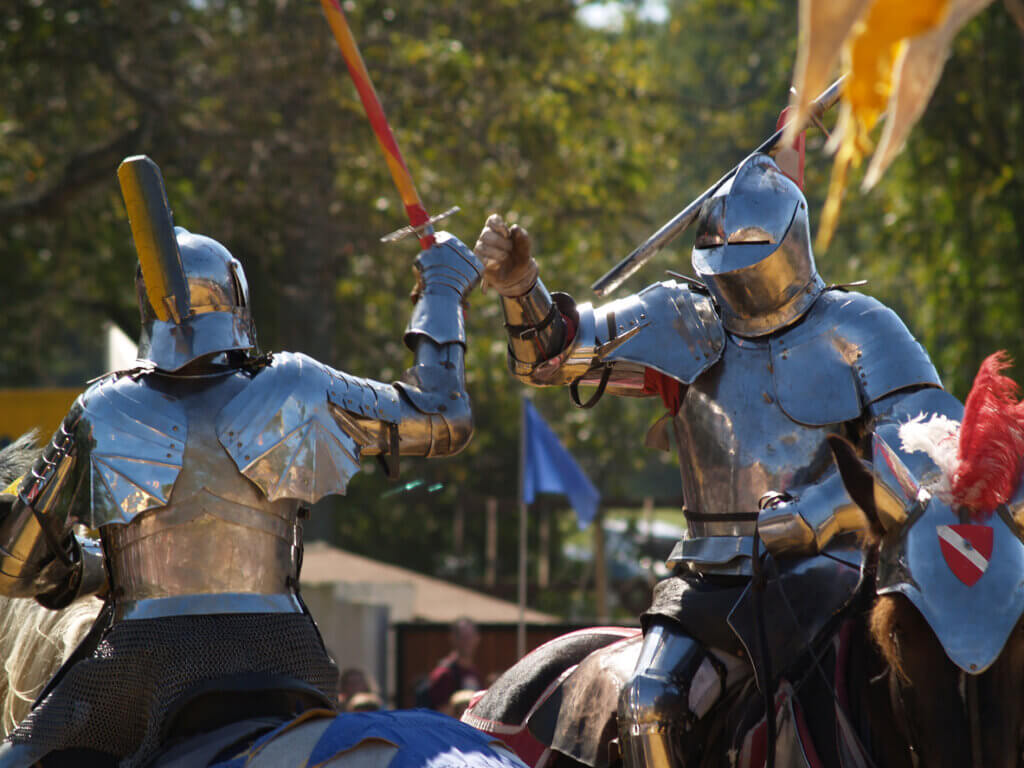
These two faires do a fantastic job recreating the historic atmosphere of Europe with also a bit of fantasy. Many thanks goes to Vendor Coordinator, Holly Irving and her dedicated team for making sure everything runs smoothly at these faires. New this year are armored combat featuring fighters in full steel armor with medieval period weapons. Performers light up the faire with music, magic, comedy, and thrilling new equestrian shows! Such talented acts feature Celtic Magic with Daniel Greenwolf & Bella and Thom Fuewellery the Wandering Comedic Bard. Daniel Greenwolf is also co-owner and entertainment director with Found Artifact Entertainment, LLC that manages these faires. Compared to festivals in Europe, and to my own observations, American acts such as these are more theatrical and highly interactive with more audience participation. They blend history and fantasy, while European festivals stay more historically grounded. American faires fill the air with lively medieval and folk tunes, while European festivals echo with authentic music straight from the Middle Ages.


Economic and Cultural Impact of American Renaissance Faires
These faires are now major tourist attractions that also greatly impact the local economy. Local communities drive these events, and for many, the passion becomes a year-round way of life. These faires act as entertainment and artistic expression along with a touch of education and value for the history buff.
Top American Renaissance Faires and Festival Settings
One quite popular faire in the U.S. is the Maryland Renaissance Festival, which has a natural wooded forest and a 16th-century English village. The wooded forest gives the visitor a more authentic rustic atmosphere. Permanent buildings such as these act as shops with merchants, food stalls, taverns, and a jousting arena. This festival is similar to the Texas Renaissance Faire in Todd Mission, Texas, which is the largest faire in the U.S. It includes a permanent village, castle entrance, and wedding chapel!


Food Culture at American Renaissance Faires vs European Medieval Festivals
When it comes to food, American Renaissance faires vs European medieval festivals reveal huge differences, but one item you’ll always find at any U.S. faire is the turkey leg. Though they didn’t eat turkey in medieval or Renaissance Europe, it nonetheless, is a very popular treat at American faires. I would classify other food at American faires as a combination of historically accurate recipes with the food found at American festivals in general. There is also some variation depending on which faire you are attending. One such food that falls under this type is fish & chips that actually dates back to 15th century Portugal. Visitors at these faires often enjoy pierogi, a beloved dish made of dough filled with flavorful meat or vegetables. Pierogi likely served as a staple food in 13th-century Eastern and Central Europe.
European Medieval Festivals: Where History Comes Alive
Medieval festivals in Europe are rooted in history and traditions. We can place these festivals into those that have been handed down through the generations with nearby neighborhoods. The neighborhoods compete for a prize and often preserve religious traditions. One festival that falls under this category is the Giostra del Saracino (Jousting of the Saracens). It takes place two times a year in June and September in the main square of Arezzo, Italy. The jousting tournament has been mentioned since 1260. It takes place between four neighborhoods where knights on horseback charge a shield for points. Breaking the shield scores double the points. Before the joust takes place an historical parade made of up of colorful participants in period clothing can be seen throughout the city streets. Flag throwing and artisans with markets make for a very merry atmosphere. After the joust visitors can dine with the participants and experience local dishes and witness community bonding. Beyond Arezzo you can also explore Unique Experiences in Rome and Florence: Tailor-Made Travel with special activities that can be treasured for a lifetime.
Immersive Historical Experiences Across Europe
You have to purchase tickets if you want to see the joust at the Jousting of the Saracens. The first time I attended this festival I put a note when I purchased my ticket that I wanted to be in the front of everyone if possible. After finding my seat I didn’t know they would seat me directly in back of the town officials including the major. It felt very special to be in those seats and was quite enjoyable.
Modern European Medieval Festival Revivals: Medieval Week in Visby, Gotland, Sweden
The second type of medieval festivals in Europe are 20th century recreations. They are usually held in historic towns that have their city square surrounded by medieval walls or near a castle. One festival that comes to mind and not to be missed is the Medieval Week in Visby, Gotland, Sweden celebrating medieval life. This festival is the largest historic festival in Sweden with over 1000,000 visitors and turns back the clock during this era for eight days at the beginning of August. Visby is a town that includes an intact 13th century wall with towers, medieval buildings, and church ruins. What is historically correct about Medieval Week is the recreation of the Battle of Visby outside its city walls that took place in 1361 when the whole island of Gotland was invaded. In addition to the battle scene is jousting, medieval markets, and lectures to learn about medieval life along with music and dance. The battle scene is extremely powerful yet emotional to watch but filled with accuracy with a spectacular surrounding. While I lived in Sweden for more than three years, I had the great opportunity to immerse myself in the culture and history of the country!

The Tuscany Medieval Festival: Italy’s Hidden Gem
Another medieval festival in Europe that is a revival of history is called the Tuscany Medieval Festival in Livorno, Italy. It is a local festival for me to attend being about an hour and a half by car or train from Florence. It takes place on the first weekend in May at an historic fort for three days including Friday. The fort is called the New Fort that was first constructed in the 1590s and was supported by the Grand Duke Ferdinand the First of the Medici to defend the city of Livorno. The Medici family ruled the city of Florence and Livorno during the Renaissance. While there is no evidence that such pageantry took place at the fort, the Medici family did hold many spectacles of celebration nearby. The inner walls of the fort are actually a public park with many events held during summer evenings. Nice city views can be seen of the surrounding canals and surrounding points of interest.


Authentic Food and Crafts at European Festivals
Full Medieval Experiences: Combat, Markets, and Music
I’ve attended the Tuscany Medieval Festival in Livorno a few times and it offers the visitor everything you would want in a medieval festival. This would include an historic location, sword fighting, full armored combat, medieval markets of handmade products and demonstrations. Other experiences include period music, a large historical parade in the historic center of the city, fantastic food, and a conclusion featuring fireworks, lights, and an orchestra performing “The Lord of the Rings” film scores in a medieval style. There was also a part of the fort with educational talks and displays to learn about the history of the New Fort including clothing worn during this era. My observation from attending different festivals in Europe over the years is that less festival goers wear period clothing than its counterpart in the U.S. This could be due in part to people in Europe not feeling the need to immerse themselves in the fantasy of dressing up as medieval castles and ruins are part of the landscape and culture.

Traditional European Festival Cuisine and Local Specialties
Visitors at the Tuscany Medieval Festival and European festivals in general enjoy authentic traditional recipes and local specialties. At these festivals, you can enjoy classic sandwiches with a variety of meats and toppings, as well as special dishes served alongside local wines and beers.
Generational Crafts and Artisanal Traditions
At European festivals, local artisans keep medieval traditions alive by crafting products passed down through generations. The La Forgia del Grifone at the Tuscany Medieval Festival caught my eye with its inviting tent, offering visitors a one-stop shop filled with specialty medieval treasures. They had everything for your medieval needs including weapons, shining helmets, ornate medieval attire, jewelry, and Viking products. Locally forged swords were also displayed at their booth, each one gleaming with craftsmanship and history. I’ve attended many medieval festivals and recreations, but the Tuscany Medieval Festival in Livorno stands out as truly special and worth visiting.


Spectacular Armored Combat Shows in European Medieval Festivals
During the Tuscany Medieval Festival different European countries compete in armored combat with axes, swords, maces, and halberds. By the early evening there are over 100 participants of knights and soldiers on the other side of this area near the main stage. There you will see traditional Italian flag flowing accompanied with the sounds of historic drums and blasting trumpets. After many flag throwing displays two sides of many soldiers come to the foreground in the same field with many demonstrations of sword and spear fighting between them. What makes this even more special is that the clothes and armor from all participants in the festival are recreated as close to the original as possible to the events that took place in the surrounding area. This festival fully displays the splendor of the period, the grandeur of tournaments, and magnificence of courtly culture.


Why You Should Visit Both American Renaissance Faires and European Medieval Festivals
Travelers should visit festivals in both the U.S. and Europe, as American faires serve as gateways to European festivals, where visitors can dive deeper into authentic experiences. Great work and detail goes into the European festivals making sure that the different components try to adhere as close to the period of history as possible. These festivals often use real medieval architecture as backdrops and with historical reenactments taking place on historical sites. Though medieval and Renaissance historical events did not occur in the U. S. nor were there castles and cathedrals built during this time, it still becomes important to recreate these historic events and culture within this time period both for repeated and new visitors.
American Renaissance Faires vs European Medieval Festivals: Challenges in Recreating European Authenticity in the U.S.
I think it is more difficult to organize American Renaissance faires vs European medieval festivals because there are no medieval castles or walled towns where such a faire can take place. We saw that some American faires have structures built to recreate the past, but others use an actual historic building as the backdrop. This includes For Mifflin in Philadelphia, Pennsylvania featuring the Philadelphia Renaissance Faire and the Moravia Pottery & Tile Works Museum in Bucks County featuring the Bucks County Renaissance Faire. Both of these buildings have their own special history and importance. In addition to historic buildings used as a backdrop there are also vendors that present not only their handmade merchandise but create an engaging exhibit of era craftsmanship. One such vendor is Vildnfri that transform their Viking-themed booth into an experience that immerses you in the Norse age complete with a Viking themed encampment along with authentic-looking, handcrafted weapons and shields, and finely stitched Viking clothing.


Most Popular American Renaissance Faires and European Medieval Festivals
Though I have given spotlight to a subset of festivals to highlight American Renaissance faires vs European medieval festivals it is by no means an exhaustive list. Below are a list of additional American and European festivals that have been quite popular over the years and that I think are worth mentioning.
Popular American Renaissance Faires
- Carolina Renaissance Festival (Huntersville, North Carolina) – October and November
- Pennsylvania Renaissance Faire (Manheim, Pennsylvania) – August and October
- Northern California Renaissance Faire (Hollister, California) – September and October
- Ohio Renaissance Festival (Waynesville, Ohio) – August and October
Popular European Medieval Festivals
- Kaltenberg Knights Tournament (Bavaria, Germany) July
- Medieval Festival of Provins (Provins, France) June
- Monteriggioni Medieval Festival (Monteriggioni, Italy) July
- Tewkesbury Medieval Festival (Tewkesbury, England) July

Planning Your American Renaissance Faire vs European Medieval Festival Journey
Best Times to Visit
While American Renaissance faires take place during late summer and early fall the majority of medieval festivals in Europe are held in July and August. Typically festivals in Europe have many sunny days but with much warmer temperatures, especially in Southern Europe. These festivals are also more crowded because it is the peak tourist season.
European Medieval Festival Travel Tips
Your preferred country in Europe to visit gives rise to certain questions that you might not have considered before. One such question is if you would you like to visit medieval festivals in cities or do you prefer smaller festivals in villages? Both of these options offer fantastic opportunities to experience medieval festivals and the local culture. However, depending on which you choose can also determine your mode of transport. If you travel by car, then it would be convenient to see both the city and countryside. If you decide with train travel you might limit your trip to more remote locations. Also, it becomes important to book accommodations early. It makes for a much pleasurable experience if you do some historical research surrounding the festivals. Knowledge of the historic sights including museums and the local basic phrases are worth learning as well.
Conclusion: Your American Renaissance Faire vs European Medieval Festival Adventure Awaits
Whether you dream of cheering at a joust beneath castle walls in Europe or enjoying a weekend of costumed merriment at a Renaissance Faire in America, both experiences invite you to relive the magic of history firsthand. Each event celebrates human creativity, artistry, and cultural pride. It has the ability to unite travelers through music, craftsmanship, and immersive storytelling. If you would like to particularly immerse yourself in the world of medieval castles in England and learn about their history with a haunted background please read England’s Haunted Castles and How to Explore Them.
Plan Your Personalized Medieval Festival Quest
Step beyond the ordinary and let history guide your next journey. Witness European medieval jousts and explore medieval castles and beyond where every trip can be tailored to your interests and schedule. Imagine arriving at a festival knowing exactly where to go, what to see, and how to experience history like a local.
Book a Free Consultation with Courtly Tours!
We’ll help you:
- Plan a custom itinerary for European festivals
- Arrange travel, accommodations, and transfers
- Recommend authentic experiences and local cuisine
- Maximize your time and avoid the crowds with insider tips
Join my email list to receive news, posts, and more!